AI brand visibility: see and shape what AI says about your brand
Getting cited is only half of it. The other half is whether the machine describes you accurately, and well.

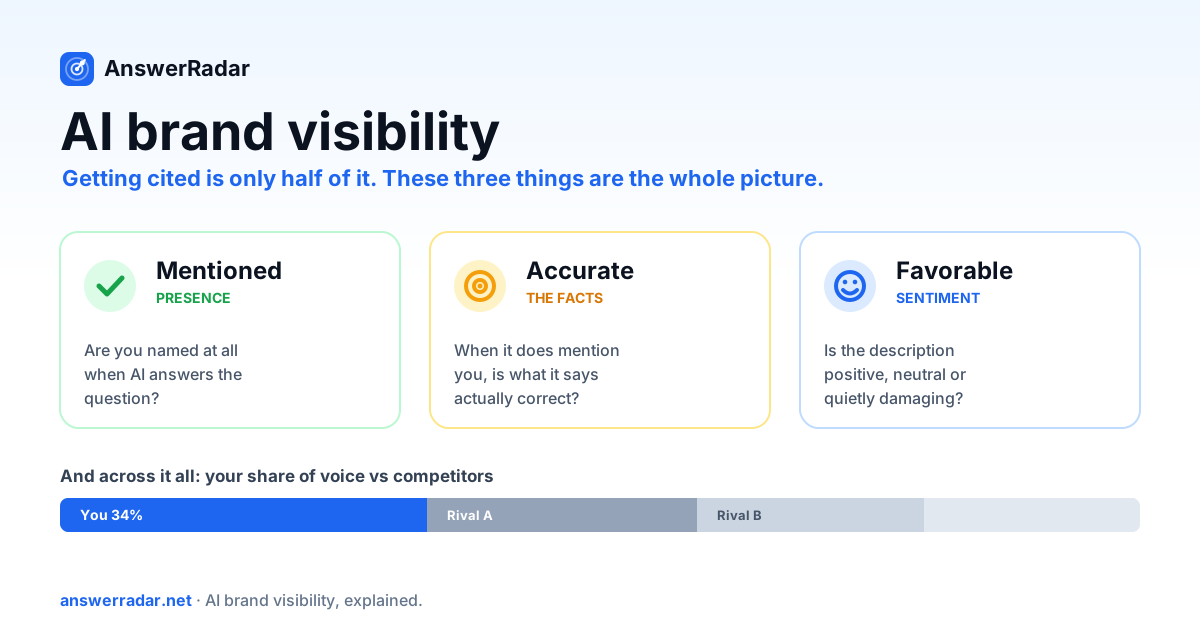
Most of the AI-search conversation is about getting cited: earning a mention or a link inside the answer. That matters, but it is not the whole story. When a buyer asks an assistant about your category, three separate things are happening at once, and a brand can win one while losing another. AI brand visibility is the view that watches all three.
What is AI brand visibility?
AI brand visibility is how often and how accurately AI assistants mention and describe your brand when people ask about your category. It spans ChatGPT, Perplexity, Gemini, Copilot and Google's AI Overviews, and unlike a simple "are we cited?" check, it asks three questions at once.
The three things it actually measures
- Presence. Are you mentioned at all when the AI answers a relevant question? If the model never names you, nothing else matters yet.
- Accuracy. When it does mention you, is what it says correct? Models confidently state wrong prices, wrong features and wrong positioning. An inaccurate mention can be worse than no mention.
- Sentiment. Is the description favorable, neutral or negative? Being named as "the expensive one" or "the one with poor support" is presence you do not want.
On top of those sits share of voice: of all the brands the AI names for your category, how big is your slice versus competitors. That is the number that tells you whether you are winning the conversation or just appearing in it.
How this differs from GEO and AEO
GEO and AEO are mostly about citation: earning the mention. AI brand visibility is the wider lens that also covers perception, accuracy and share of voice. The underlying work overlaps a lot, but the question is different. GEO asks "am I cited?" Brand visibility asks "am I mentioned, is it right, and is it good?" You need both: there is no point being cited if the citation describes you wrongly.
Why it matters now
When someone reads a page about you, you wrote it. When an AI summarizes you, the model did, from a blend of sources you may not control, and the user often takes that summary as fact without clicking through. That makes the AI's version of your brand a real asset or a real liability, and most brands have never checked what it actually says.
How to measure your AI brand visibility
The method is the same evidence-first loop I use for everything: define the questions, run them, record what comes back, repeat on a schedule.
- Write the real questions your buyers ask, including category questions ("best [category]?") and brand questions ("Is [brand] worth it?", "[brand] vs [competitor]").
- Run them through the engines your audience actually uses.
- For each answer, record three things: were you mentioned, was it accurate, was the tone positive. Note who else got named.
- Repeat on a fixed cadence so you can see movement, not noise. AI answers vary run to run, so sample more than once.
To build a realistic prompt set in a couple of minutes, start with my free AI Visibility Checker, then follow how to track your AI visibility for the repeatable routine. When doing it by hand across many prompts and engines gets tedious, that is what the AI-visibility tools automate, several of them track sentiment and share of voice specifically.
How to improve it
You cannot edit a model's answer directly, so you change what it learns from. The levers, in order of leverage:
- Be an unmistakable entity. A clear about page, a consistent one-line description, named people, and Organization and Person schema make you easy to identify and describe correctly.
- Make your key facts consistent everywhere. If your pricing, positioning and category differ across your site, directories and profiles, the model picks one at random. Align them.
- Earn corroboration. Mentions and consistent facts across other credible sources are what make a model confident enough to repeat your version, and favorable framing more likely.
- Publish the answer to the unflattering question. If the AI calls you "expensive", publish the honest value case. Models often pull their framing from whoever addressed it clearly.
When AI gets your brand wrong
A single hallucination is not something you can delete, and chasing one answer is a waste of time because it changes between runs. Fix the record instead: correct first-party content, consistent facts across the web, and corroboration from trusted sources. Models converge on what many credible places agree on, so improving the wider record is what shifts the answer, slowly but durably. If the inaccuracy is serious and spreading, the fastest lever is usually publishing a clear, authoritative page that states the correct fact plainly, so the model has something better to pull from.
The tools that help
You can track presence, accuracy and sentiment by hand, and you should at least once to understand it. Past a handful of prompts it gets tedious, which is what the category of AI-visibility tools exists for, with several built specifically around brand monitoring, sentiment and share of voice. See my ranked list of the best AI-visibility tools, or browse every tool I track.
Frequently asked questions
What is AI brand visibility?
AI brand visibility is how often and how accurately AI assistants like ChatGPT, Perplexity, Gemini and Google AI Overviews mention and describe your brand when people ask about your category. It covers three things: whether you are mentioned at all, whether what the AI says about you is correct, and whether it is favorable, plus how you compare to competitors inside those answers.
How is AI brand visibility different from GEO or AEO?
GEO and AEO are mostly about getting cited: earning a mention or link inside an AI answer. AI brand visibility is the wider view that also covers brand perception, whether the AI describes you accurately and positively, and your share of voice against rivals. The work overlaps, but the question is different: GEO asks "am I cited?", brand visibility asks "am I mentioned, right, and well-regarded?".
How do I check what AI says about my brand?
Ask the AI engines your buyers use the questions they would actually ask, including some that name your brand directly ("Is [brand] any good?", "[brand] vs [competitor]"). Record whether you are mentioned, whether the facts are correct, and the tone. Do it on a schedule so you can see change. A free checker can generate the prompt set; AI-visibility tools automate it across many prompts and engines.
What do I do if AI describes my brand wrong?
A single hallucination is hard to edit directly, so fix the source instead. Publish clear, correct first-party content (a strong about page, accurate product pages), make your key facts consistent everywhere you appear, and earn corroboration from other credible sources. Models lean on what multiple trusted places agree on, so correcting the wider record is what moves the answer over time.