Answer engine optimization (AEO): the practical guide
How to become the answer a machine gives back, not just a link in a list it ignores.

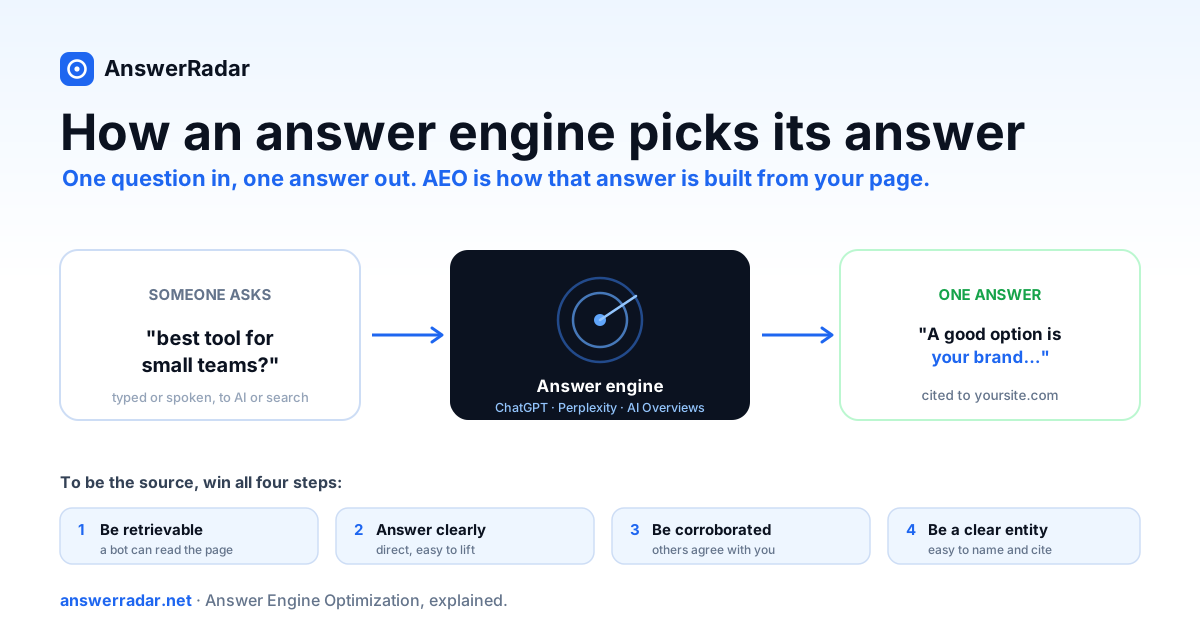
Search is quietly splitting into two experiences. One is the familiar list of blue links. The other hands you a single written answer and, if you are lucky, a citation. That second experience is an answer engine, and optimizing for it is a different job from classic SEO. This guide is the practical version: what AEO actually is, how an answer engine decides what to say, and the specific work that gets you quoted instead of skipped.
What is answer engine optimization?
Answer engine optimization (AEO) is the practice of structuring your content so an answer engine can lift a clean, accurate answer from your page and attribute it to you. An answer engine is any system that returns one direct answer instead of ten links: a Google featured snippet, a voice assistant reading a result aloud, a People Also Ask box, and the AI assistants that now write a paragraph in response to a question, such as ChatGPT, Perplexity, Gemini and Google AI Overviews.
The shift matters because the user often never leaves the answer. If the machine quotes a competitor, you do not get the click, the visit or the sale, even if you rank well in the old list of links. AEO is how you make sure the answer is built from your content.
What counts as an answer engine
- Classic answer features: featured snippets, People Also Ask, and the knowledge panel in Google.
- Voice assistants: Siri, Alexa and Google Assistant, which read a single result aloud.
- AI answer boxes: Google AI Overviews and AI Mode that sit above or instead of the links.
- Generative assistants: ChatGPT, Perplexity, Gemini, Copilot and Claude, which synthesize an answer from many sources.
The first three have existed for years. The last category is why AEO is suddenly urgent: assistants are becoming where people start a question, and they summarize rather than list.
How an answer engine chooses what to say
You cannot optimize a system you do not understand, so here is the mechanism in plain terms. An answer engine does four things, and each one is a place you either win or lose:
- Retrieve. It gathers candidate passages from pages it can crawl, render and has indexed. If a bot cannot read your page, you are not even a candidate.
- Rank by extractability. It favors passages that answer the question directly and are easy to lift: a clear definition, a short list, a specific number, placed near the top of a relevant section.
- Check for corroboration. Especially for generative assistants, it leans toward claims that several credible sources agree on, because a lone, unverifiable claim is risky to repeat.
- Attribute. It names or links the source it trusts. Entity clarity, a recognizable brand and author, and structured data all make you easier to attribute.
Notice that only one of those four steps is about writing. The others are about being crawlable, being corroborated, and being a recognizable entity. That is why AEO is more than good prose.
AEO, SEO and GEO: how they fit together
AEO is not a replacement for SEO. It sits on top of it. SEO gets you crawled, indexed and ranked; AEO makes the answer on your ranked page easy to extract and trust. GEO (generative engine optimization) is the subset of AEO aimed specifically at generative assistants. If the acronyms blur together, that is fine, because the underlying work overlaps by roughly 80%. For the distinction in detail, see AEO vs GEO, and for the citation mechanism inside assistants, see what is GEO.
The AEO playbook
This is the work, in the order I would do it for a real site. None of it is a hack; it is making your content legible and trustworthy to a machine.
1. Fix retrievability first
Before anything clever, confirm an engine can actually read the page. Content that only appears after JavaScript runs, pages blocked in robots.txt, and slow or broken rendering all remove you from the candidate pool. Check that the answer exists in the raw HTML, not just the rendered DOM. I have watched teams chase "AEO tactics" on pages a crawler could not render, which is decorating a room with no floor.
2. Answer the question first, then elaborate
Lead each section with a direct, self-contained answer of two or three sentences, then expand below it. An answer engine wants a passage it can quote without stitching together paragraphs. If your definition is buried under a warm-up, the engine quotes whoever got to the point faster.
3. Write headings as the questions people ask
Phrase H2s and H3s as real questions ("How much does X cost?", "Is X safe for Y?") and answer them immediately underneath. This matches how people query assistants and makes each section an extractable unit. Pull the exact phrasing from real demand, not guesses.
4. Add schema that clarifies, not decorates
Use Article, Organization and Person schema to tell a machine what a passage is and who published it, and BreadcrumbList to place it in your site. A note on FAQ and HowTo markup: Google retired both as rich results (HowTo in 2023, FAQ for most sites in 2026), so they no longer earn special search features, though clear question-and-answer content still helps a machine (and a reader) extract the answer. Schema is a clarity aid: it helps extraction and attribution when the content genuinely answers the question, and does nothing when it does not. Do not mark up content that is not actually on the page.
5. Make your entity unambiguous
Engines attribute answers to entities they recognize. Give yourself a clear about page, a consistent one-line description used everywhere, named and credentialed authors, and consistent name, logo and profiles across the web. The easier you are to identify, the easier you are to cite.
6. Earn corroboration off-site
A claim only you make is a claim an assistant hesitates to repeat. Mentions, citations and consistent facts about you across other credible sources, such as directories, reviews, reputable editorial and relevant communities, make your claims safe to echo. This is the slowest lever and the most durable one.
7. Keep it current and author-attributed
Show published and updated dates, attribute content to a real author with a bio and profiles, and refresh pages when facts change. Freshness and authorship are trust signals that make an engine more willing to treat your page as the source.
How to measure AEO
You cannot improve what you do not measure, and AEO has no single dashboard the way rankings do. The method is simple and manual to start: list the real questions your buyers ask, run them through the engines your audience actually uses, and record whether you are mentioned, cited or linked. Repeat on a fixed schedule so you can see movement rather than noise.
To generate a realistic prompt set in a couple of minutes, start with my free AI Visibility Checker. For the full measurement routine, including how to turn this into a repeatable monthly check, see how to track your AI visibility. When doing it by hand gets tedious across many prompts and engines, that is what the AI-visibility tools exist to automate.
Common AEO mistakes
- Treating AEO as a replacement for SEO. It is a layer on top. Weak foundations sink it.
- Optimizing for a label instead of the work. AEO, GEO, whatever you call it, the fundamentals are the same.
- Marking up content that is not on the page. Schema that does not match the visible content is a liability, not a win.
- Guessing the questions. Optimize for the phrasing people actually use, pulled from real demand data, not what you assume they type.
- Chasing every engine equally. Prioritize the engines your buyers use, which you learn by measuring, not guessing.
The tools that help
You can run AEO measurement by hand, and you should at least once to understand it. Past a handful of prompts and engines it gets tedious, which is the entire reason the category of AI-visibility tools exists. See my ranked list of the best AI-visibility tools, the free options if you just want to start, or browse every generative engine optimization tool I track.
Frequently asked questions
What is answer engine optimization (AEO)?
Answer engine optimization (AEO) is the practice of structuring your content so an answer engine, a system that returns one direct answer instead of a list of links, can lift a clean, accurate answer from your page and attribute it to you. Answer engines include Google featured snippets, voice assistants, People Also Ask, and AI assistants like ChatGPT, Perplexity and Google AI Overviews.
Is AEO the same as SEO?
No, but it depends on SEO. SEO gets your page crawled, indexed and ranked. AEO is a layer on top that makes the answer on that page easy for a machine to extract and trust. If a crawler cannot render or understand your page, AEO has nothing to work with, so you do SEO first and AEO second.
What is the difference between AEO and GEO?
They overlap heavily. AEO is the older, broader term covering all answer surfaces (snippets, voice, AI answers). GEO (generative engine optimization) narrows the focus to generative assistants like ChatGPT and Perplexity, where the goal is to be named and cited inside the written answer. In practice most of the work is identical.
How do I measure answer engine optimization?
Pick the real questions your buyers ask, run them through the engines that matter to your audience, and record whether you are mentioned, cited or linked. Do it on a fixed schedule so you can see movement. A free checker can generate the prompt set for you, and AI-visibility tools automate the tracking across many prompts and engines.
Does schema markup help with AEO?
Yes, within limits. Article, Organization, Person and BreadcrumbList schema help a machine understand what a passage is and who published it, which supports extraction and entity recognition. Note that Google retired the FAQ and HowTo rich results, so that markup no longer earns special search features, though clear question-and-answer content still aids extraction. Schema is a clarity aid, not a ranking cheat: it works when the underlying content genuinely answers the question, and does nothing when it does not.