LLM SEO: how to show up in large language model answers
A language model knows about you in two completely different ways. Understand both and you know exactly what to work on.

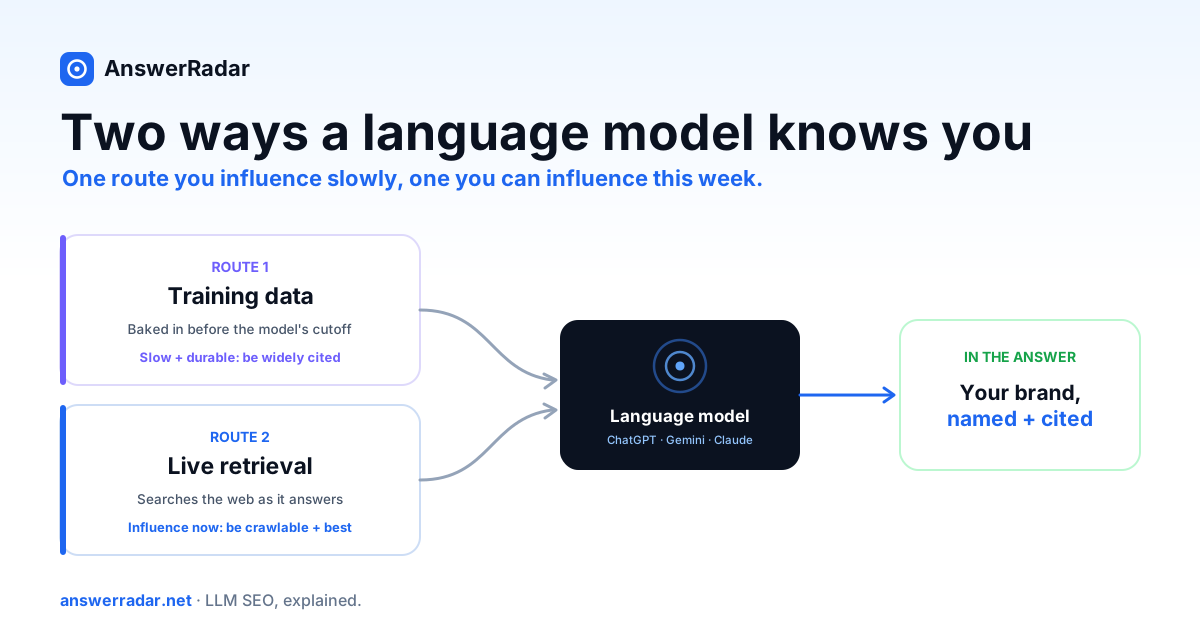
"LLM SEO" sounds like a brand-new discipline, but it rests on one idea that makes the whole thing clear: a large language model can know about your brand in two completely different ways, and they call for different work. Get that distinction and the tactics stop feeling like guesswork.
What is LLM SEO?
LLM SEO is the practice of getting your brand, pages and claims to appear in the answers that large language models produce, whether that is ChatGPT, Gemini, Claude, Copilot or Perplexity. The win is being named, cited or quoted inside the written answer. It is the same job the industry also calls GEO and AEO; "LLM SEO" is just the framing that puts the model itself at the center.
The two ways a model knows about you
This is the whole guide in one section. Everything else follows from it.
1. Training data (baked in, before a cutoff)
A model is trained on an enormous snapshot of the web and licensed sources taken before a fixed cutoff date. Whatever the model "just knows" without looking anything up comes from here. You cannot submit your site to training data or buy your way in. You influence it the slow way: by being widely published, consistently described, and corroborated across many credible sources, so that the next time a model trains, your brand is simply part of the ambient knowledge it absorbs. This is durable and powerful, and it moves on the timescale of model releases, not weeks.
2. Live retrieval (fetched at answer time)
Increasingly, models do not rely on memory alone. When asked something recent or specific, they search the live web, read a handful of pages, and write an answer from what they find, with citations. This route you can influence right now: if your page is crawlable, clearly the best answer, and easy to extract from, the model picks it when it searches. Retrieval is where fast wins live.
Which route should you work on?
Both, but start with retrieval because you control it today. For anything new, time-sensitive or niche, the model has to look it up, and that is your opening. Training-data presence is the long game: it builds the default familiarity that makes a model mention you even without searching. A serious program feeds both, and the good news is the same work largely serves each: credible, well-structured, widely-corroborated content helps you get retrieved now and absorbed into the next training run later.
The LLM SEO playbook
- Be retrievable. Confirm AI crawlers can fetch and render your pages, and that your key answers exist in the raw HTML. If a bot cannot read it, neither route works.
- Answer in liftable chunks. Lead each section with a direct, self-contained answer the model can quote without stitching paragraphs together.
- Be a clear entity. A consistent name, one-line description, named authors and structured data make you easy to recognize and attribute, in retrieval and in training.
- Earn corroboration. Mentions and consistent facts about you across trusted sources are what make a model comfortable repeating your claims, and what seeds the next training snapshot.
- Stay current and dated. Freshness helps retrieval choose you and signals a page worth trusting.
- Target real questions. Optimize for the phrasing people actually use, pulled from real demand, not assumptions.
If the mechanics of how engines decide what to cite are new to you, read what is GEO first, then the full answer engine optimization playbook.
How to measure it
Pick the real questions your buyers ask, run them through the models your audience uses, and record whether you are named, cited or linked, on a fixed schedule. My free AI Visibility Checker generates a realistic prompt set in minutes, and how to track your AI visibility turns it into a repeatable routine. To automate it across many prompts and models, that is what the AI-visibility tools are for.
Frequently asked questions
What is LLM SEO?
LLM SEO is the practice of getting your brand, pages and claims to show up in the answers that large language models like ChatGPT, Gemini, Claude and Perplexity produce. It covers two routes: being present in the data a model was trained on, and being retrievable when a model searches the live web before answering. It overlaps almost entirely with GEO and AEO.
How is LLM SEO different from normal SEO?
Normal SEO optimizes for a ranked list of links a person clicks. LLM SEO optimizes for a written answer the model assembles, where the win is being named, cited or quoted inside that answer. It still depends on SEO fundamentals, because a model that searches the web uses a search index, but the unit of success is a mention, not a position.
Can I get into a model’s training data?
Not directly or on demand. Training data is a broad snapshot of the web and licensed sources taken before a cutoff date. You influence it the slow way: by being widely published, consistently described and corroborated across many credible sources over time, so that when the next model trains, your brand is part of the ambient knowledge it absorbs.
Which matters more, training data or retrieval?
For anything new or fast-moving, retrieval matters more and you can influence it now: make your pages crawlable, structured and clearly the best answer, so the model picks them when it searches. Training-data presence is the long game that builds durable, default familiarity with your brand. Serious programs work on both.