How to improve your AI visibility: a practical playbook
You cannot edit what the model says. You can change everything it reads. Here is the order I work in.

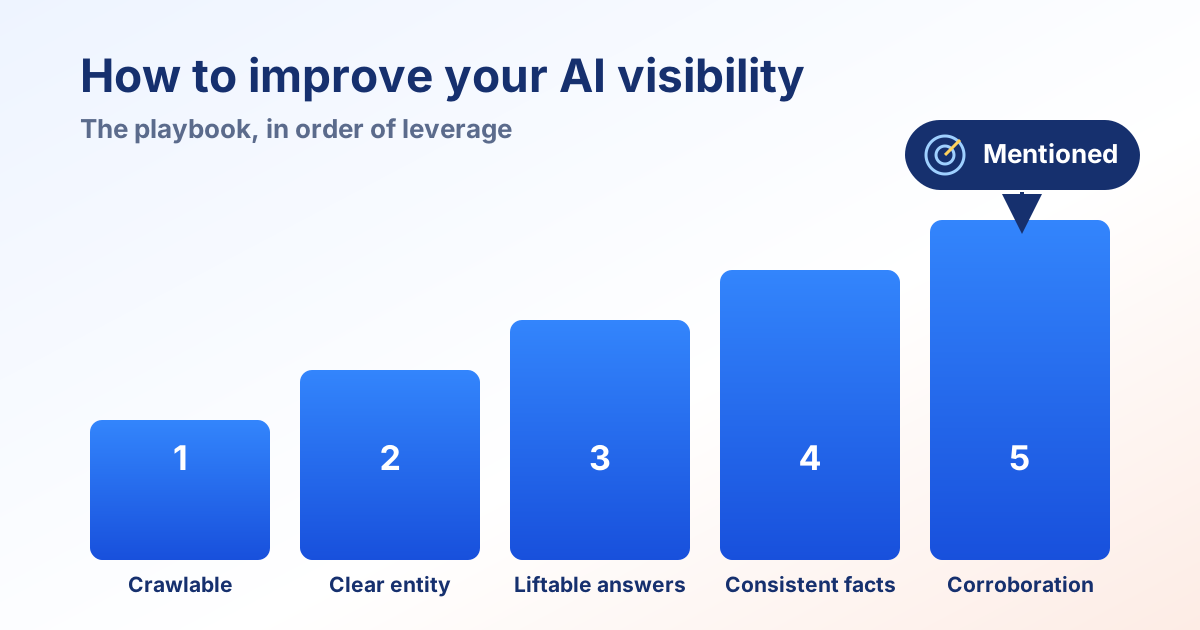
Once you have measured where you stand, the obvious next question is how to move it. The frustrating part of AI search is that you cannot open the answer and fix it. A model writes a fresh response each time from a blend of what it learned in training and what it retrieves live. So you do not edit the answer, you improve the sources it builds the answer from. Everything below is ordered by leverage: do the top items first, because the lower ones barely matter if a bot cannot reach and read your page in the first place.
First, understand the two inputs you can influence
A model knows about you in two ways. Memory is what it absorbed during training, which changes slowly and only when the wider web does. Retrieval is what it fetches live from search at answer time, which you can influence within days once your pages are crawled again. Most of the fast wins live in retrieval, so that is where this playbook starts.
The playbook, in order of leverage
1. Be crawlable and renderable
An engine can only use a page its crawler can fetch and read. Confirm the AI crawlers are not blocked in robots.txt, that your important content is in the HTML rather than painted in later by JavaScript the bot will not run, and that nothing critical hides behind a click or a login. This is unglamorous and it is the single most common reason a brand is invisible: the content exists, but the machine never sees it.
2. Be an unmistakable entity
Models reward brands they can identify with confidence. Give them a clear about page, one consistent one-line description of what you are, the real people behind the work, and Organization and Person schema that ties it together. When a model is sure who you are, it is far more willing to name you and far less likely to describe you wrongly. Ambiguity is what gets you left out or mixed up with someone else.
3. Write answers a model can lift
Answer engines favor a direct, self-contained response over one buried under three hundred words of warm-up. Lead with the answer, then support it. Use plain headings that match real questions, short paragraphs, and clear lists where they fit. The test is simple: could a model quote one of your paragraphs as the answer without editing it? If yes, you are quotable. See the full breakdown in my guide to answer engine optimization.
4. Keep your key facts identical everywhere
If your pricing, positioning and category say one thing on your site, another on a directory and a third on your social profiles, the model has no reliable version to repeat, so it picks one, sometimes the wrong one. Align the facts that matter across every place you appear. Consistency is what lets a model state something about you confidently instead of hedging or guessing.
5. Earn corroboration
Models lean on what several credible sources agree on. A claim that only your own site makes is weak; the same claim echoed across other trusted places is what a model will confidently repeat, and repeat favorably. This is the slow, durable work: genuine mentions, listings and references that line up with the story you tell about yourself. It is also the hardest to fake, which is exactly why it carries weight.
6. Cover the questions buyers actually ask
Visibility is won question by question, not in the abstract. Map the real prompts your buyers use, the category ones ("best [category]?") and the brand ones ("is [brand] worth it?", "[brand] vs [competitor]"), and make sure you have a clear, liftable answer for each. Comparison questions are especially winnable because fewer brands address them head on.
Where the engines differ
The fundamentals above move all of them, but the emphasis shifts by engine. ChatGPT blends trained memory with live web search, so being findable on the open web and being a clear entity both count (more on ChatGPT specifically). Perplexity is retrieval first, so fresh, crawlable, quotable pages show up fastest. Google AI Overviews lean on the same signals as classic Google plus helpful, well-structured content, so strong technical SEO carries over. Gemini sits close to Google. You do not need a separate strategy per engine; you need the fundamentals done well, then minor tuning.
Common mistakes that waste the effort
- Chasing a single answer. AI responses vary run to run. Fixing one output is pointless; fix the inputs and sample repeatedly.
- Keyword-stuffing for robots. Models reward clarity, not density. Write for a person; the machine reads the same text.
- Skipping measurement. If you are not tracking presence, accuracy and sentiment on a schedule, you cannot tell improvement from noise.
- Ignoring accuracy and tone. Being mentioned wrongly, or as "the expensive one", is not a win. Watch brand visibility, not just whether you appear.
Measure, then repeat
Improvement you cannot see is improvement you cannot defend. Run the loop: make a change, wait for recrawl, re-check the same prompts, compare. Start with the free AI Visibility Checker to build your prompt set, follow how to track your AI visibility for the routine, and when doing it by hand across many prompts and engines gets tedious, that is what the AI-visibility tools automate.
Frequently asked questions
How do you improve AI visibility?
You cannot edit an AI answer directly, so you improve the inputs it draws from. In order of leverage: make your pages crawlable and renderable, become an unmistakable entity (clear about page, consistent one-line description, Organization and Person schema), write direct liftable answers, keep your key facts identical everywhere you appear, and earn corroboration from other credible sources. Then measure on a schedule so you can see what moved.
How long does it take to improve AI visibility?
Retrieval-based engines like Perplexity and Google AI Overviews can reflect changes within days to weeks of your pages being crawled again. Memory-based recall (what a model "knows" without searching) changes slowly and only when the wider web does. Expect quick wins on live-retrieval engines and slow, compounding gains on the rest.
Is improving AI visibility the same as SEO?
It overlaps heavily. Crawlability, clear content, structured data and credible mentions help both. The difference is emphasis: AI engines favor a single liftable answer and a clearly identified entity over a page that ranks by links alone. Most good technical SEO helps your AI visibility; a few things (being quotable, being an unambiguous entity) matter more here than in classic search.
Can you pay to appear in AI answers?
Not for the organic answer itself, in the same way you cannot pay for an organic search ranking. You improve it by being easy to find, easy to understand and widely corroborated. Some engines are adding ad formats, but those are labeled placements, separate from whether the model recommends you on merit.